The PR you actually asked for — without leaving the ticket you're on.
Tag a ticket in your issue tracker. A fleet of agents plans it, builds it, reviews the code, verifies the requirements, and runs QA — so it lands far further along than anything you use today.
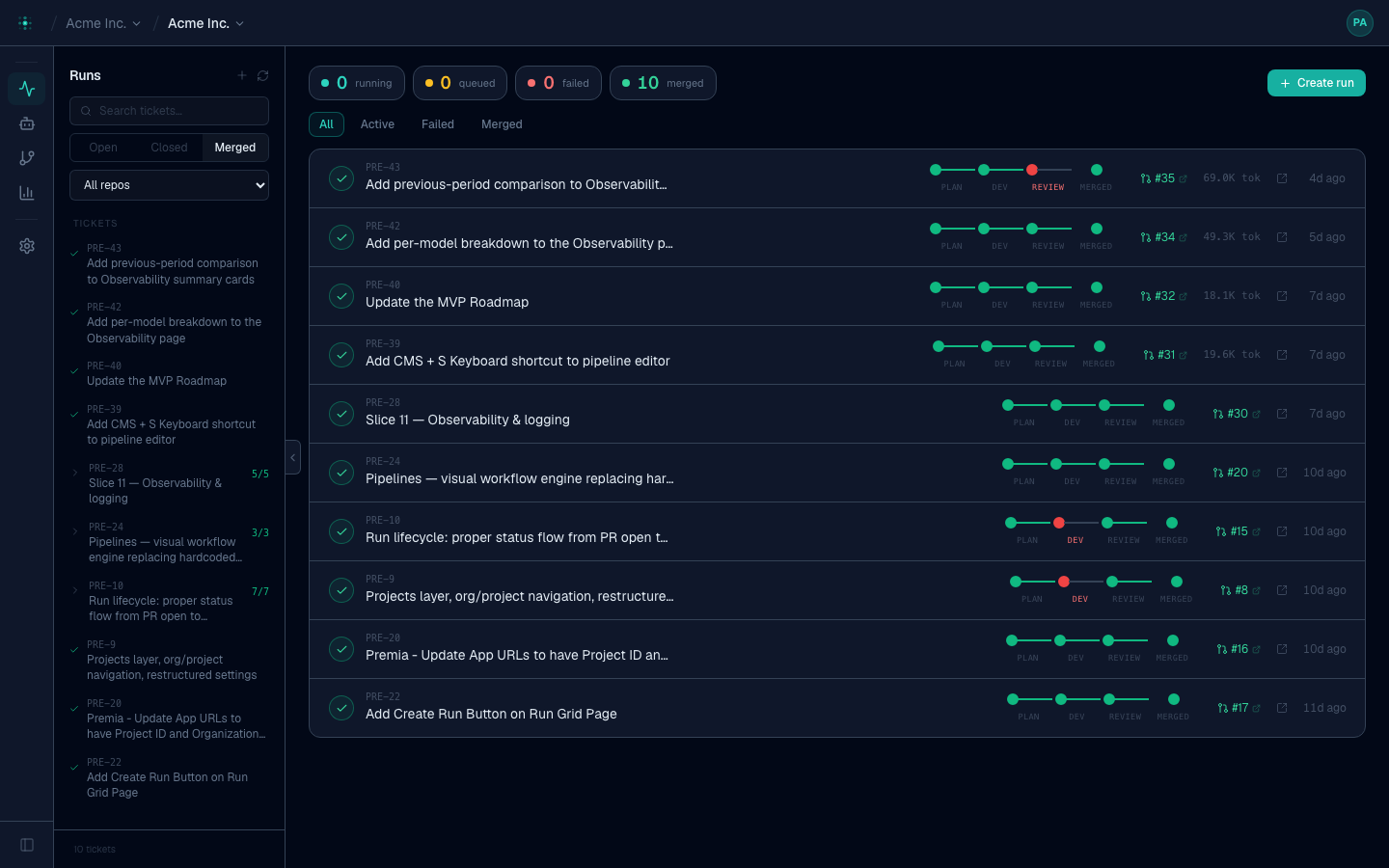
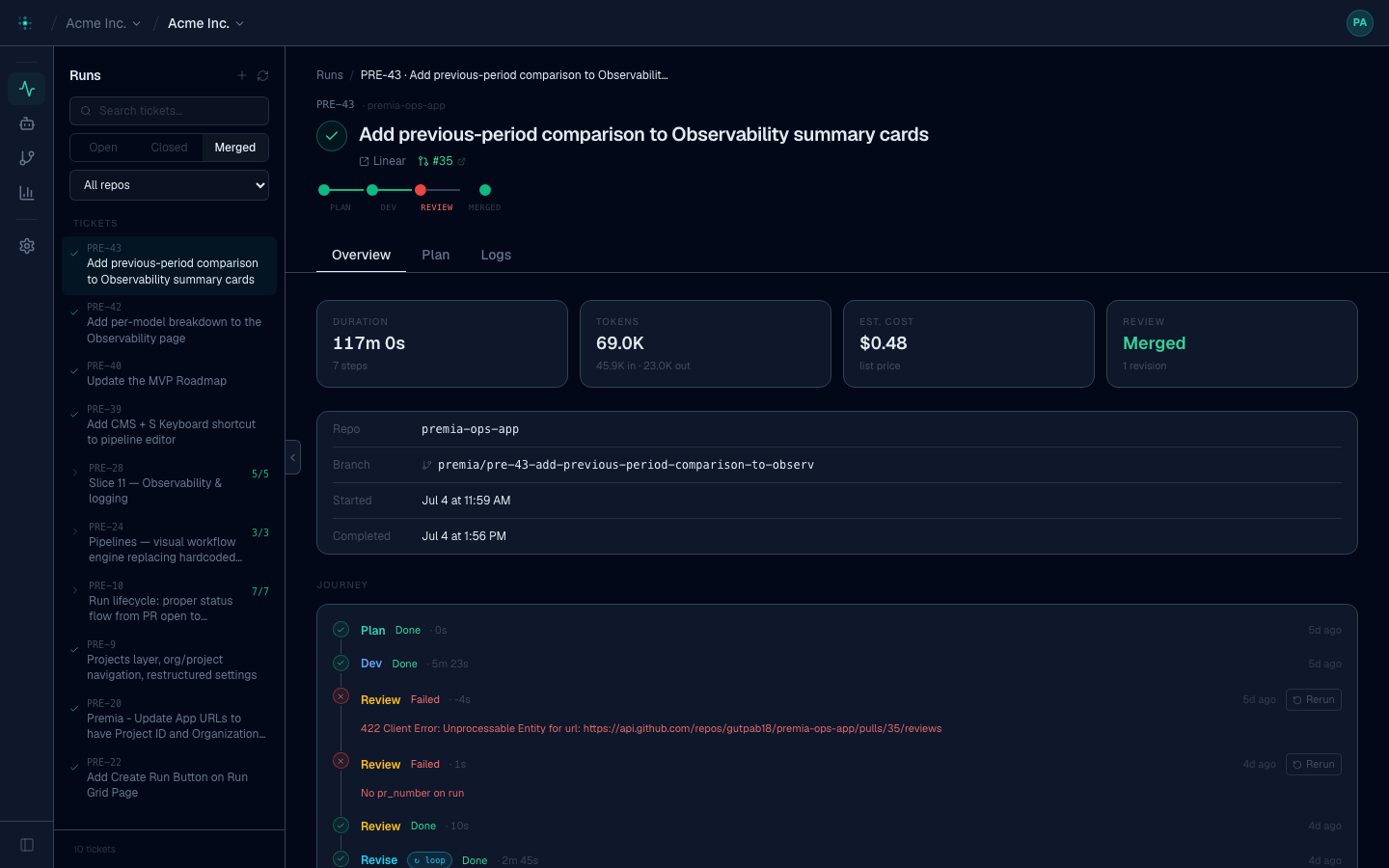
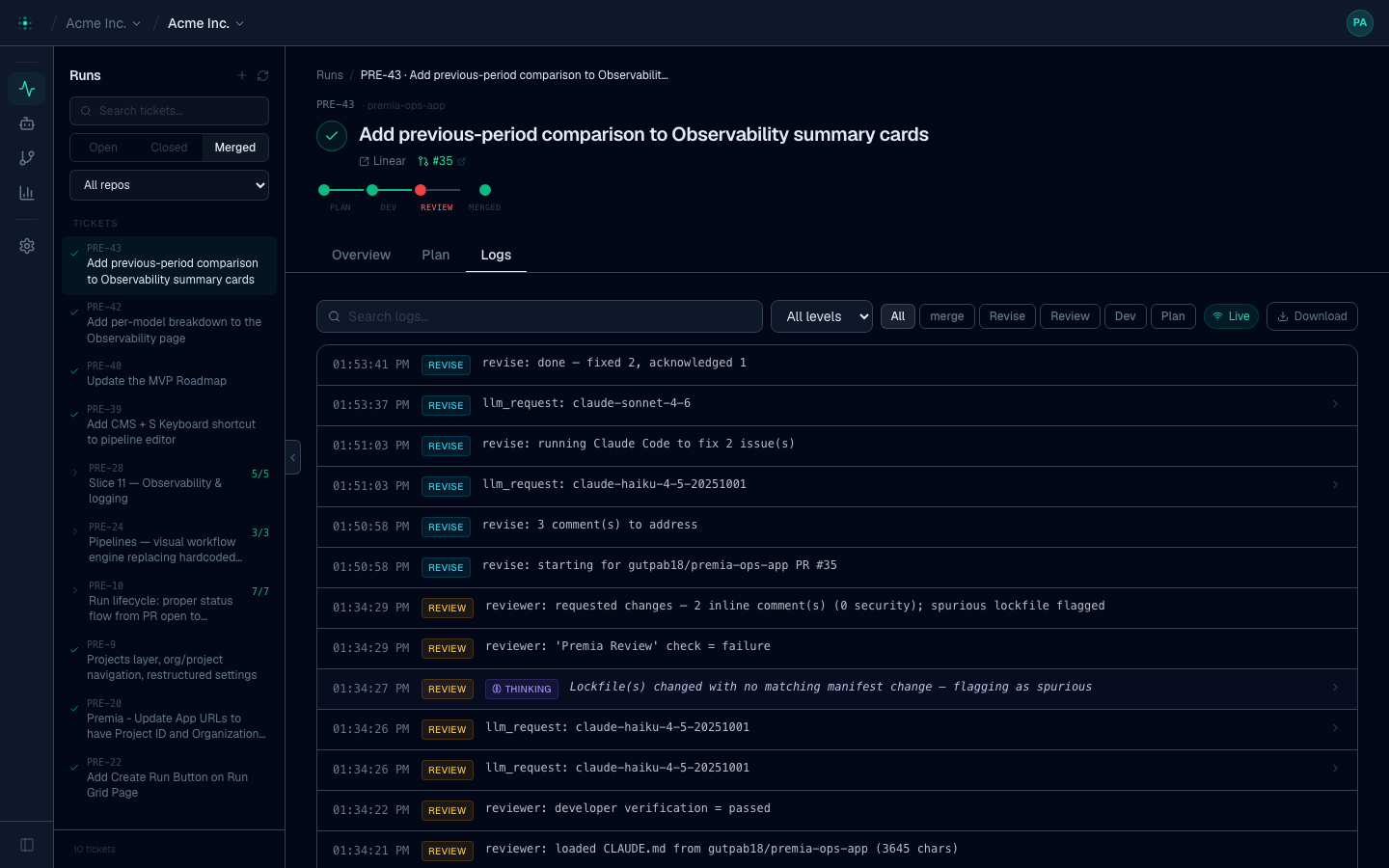
Your backlog, with a fleet of agents working it.
For engineering teams that tried AI agents and ended up doing the work anyway.
Your “autonomous” agents aren't delivering — you are.
Even with today's coding agents, shipping a single ticket still pulls your best engineers in for days.
The reality today — one ticket, with an off-the-shelf coding agent
You write the plan yourself
Hand it a vague ticket and quality tanks — so you spec it out by hand first.
CI is red, and it can't tell you why
An 80%-there PR, red tests, and no idea what broke — it never ran your suite.
You pull the branch and finish it yourself
You check it out, fix it, and merge it yourself — the work you were offloading.
The agent produced a first draft. You did the planning, the testing, the fixing, and the merging.
So you're left wondering — why does every agent stop right before the finish line?
A complete agent pipeline, already built and running
Everything between a ticket and a mergeable PR — the agents, the review gates, the test loop, the cost controls. You connect a repo and an issue tracker; that's the setup.
Nothing in your stack changes.
Keep your issue tracker, your repos, your CI, and your own model keys — no migration, no new tool for your team to learn. The PRs just start showing up for review.
Months of platform work you don't do
Orchestration, retries, context management, caching, cost tracking, evals. Teams burn months on this plumbing before their first good PR, or never get to it at all. It's built, it's running, and it's further along than what you'd ship in-house.
A fleet of agents, not one model
A planner, a developer, a code reviewer, QA, a requirements agent that asks whether it solved the right problem, a reviser that fixes whatever a gate rejects, and a rebase agent that resolves conflicts when branches drift. Each does one thing well. Add your own and shape the pipeline to match how your team ships.
It gets the code to mergeable
Runs your test suite, reads the failure, revises, and re-reviews — looping until your gates pass. What reaches you has already been through CI and code review, so you're reviewing work, not debugging a draft.
It gets better the more you use it
Every review comment you leave feeds back in, alongside your codebase's own conventions. Each PR needs fewer changes than the last — on your repo, not a generic benchmark.
Everything you'd have to build — already built
The depth that turns a coding agent into a teammate you trust to merge.
Grounded in your knowledge
Agents pull from your org's docs, ADRs, and codebase — following your conventions and context, not generic defaults.
Reacts when things break
A failing test, a red CI check, a branch that drifted out of date — agents read the actual failure, fix it, and re-run. Most tools stop at telling you.
Most tools stop halfway
Every piece of autonomous delivery half-exists — none of them close the loop all the way to a merged PR.
Coding copilots
Autocomplete inside your editor.
Where it stops
Needs you at the keyboard — it has your whole attention until the PR is done.
Premia
Takes a whole ticket end to end in the background, so you stay on your own work.
One-shot agents
Attempt a task end to end.
Where it stops
Single repo, thin review, heavy human cleanup.
Premia
Multi-repo, with code + requirements review and your tests, plus a revision loop until it's mergeable.
CI / test bots
Run checks on a PR.
Where it stops
Tell you it's broken — they don't fix it.
Premia
Reads the failing test, the red check, or the merge conflict, fixes it, and re-runs — autonomously.
DIY agent stacks
Build the orchestration yourself.
Where it stops
Months on context, caching, cost tracking, evals.
Premia
Ships all of that as the platform. Start at week 8, not week 0.
Without that last column, a human still closes every loop by hand.
Premia closes the loop
From a labeled ticket to a merged PR — planned, built, reviewed, tested, and shipped, with full logs and cost.
Trust & control
Your code stays yours.
You're letting agents into your codebase. Here's exactly what we keep, what we don't, and how much you control — no blind trust required.
Your code isn't training data
Bring your own model keys and calls run in your own account. Our hosted models run in isolated environments that aren't publicly available.
Isolated, ephemeral runs
Each run checks out your code into a fresh sandbox that's destroyed the moment it finishes.
See exactly what we keep
Plans, run logs, PR metadata, and an embeddings index of your codebase — all visible to you, isolated to your org, and never pooled across customers.
You decide what's stored
Turn off codebase indexing, set log retention, or delete your data. Tell us what you don't want kept and we respect it.
You hold every gate
Approve the plan before any code, and review and merge every PR yourself. Nothing auto-merges unless you turn it on.
Spend caps & full audit
Hard budgets per run and per org, and every action logged and replayable. Nothing happens off-screen.
Your tools. Your cloud. Your models.
Connect what you already have, drive it your way, and run it on any cloud with any model — no lock-in.
A full dashboard
One platform to launch, watch, and manage every agent and run — live logs, cost, and controls all in one place.
CLI & API
Kick off runs, tail logs, and manage agents from your terminal — or wire Premia straight into CI with the API.
Read the CLI docs→Your cloud
Run fully managed on our cloud, or bring your own provider. Move to AWS or GCP tomorrow and only the execution layer changes.
Your models
Bring your own key — Anthropic, OpenAI, Gemini — or run on our hosted open-source models to cut cost on high-volume work.
Who is building this
Built by engineers who have shipped and scaled software at some of the world's most demanding companies.
A career across financial infrastructure, payments, and high-traffic platforms — the kind of places where reliability isn't optional.
Where we've built





We're onboarding 5 teams to start.
We set each team up ourselves and stay close while you run it, so we're taking a few at a time. Free through the pilot — point it at a real ticket and judge it by the PR.
Get startedFrequently asked questions
Common questions about Premia and how it ships code.
Copilots autocomplete inside your editor while a human drives. Premia takes a whole ticket and returns a merged PR — it plans, writes, reviews, tests, and revises across all your repos, with no one at the keyboard.
Only if you tell it to. By default every PR waits for your approval. Auto-merge is off until you turn it on for a pipeline you trust — you're always in control of what actually lands.
Every change passes multiple gates — code review, a requirements check, and your own test suite — with a revision loop that fixes issues and re-checks until it's ready. Under the hood we run the context management, caching, cross-PR review, and evals that make autonomous output reliable.
Sprawling, underspecified epics and changes that need product decisions mid-flight still want a human driving. Premia shines on well-defined tickets across one or more services — the everyday backlog, done well.
Yes. The Planner breaks a ticket into per-repo tasks and agents work them in parallel, opening a PR in each repo the change touches — then coordinating them.
You choose the model per project, and BYOK (Anthropic, OpenAI, and more) is available on every plan — including Free. Use your own key and you pay the provider directly; use hosted models and it's metered on your invoice.
GitHub, plus your issue tracker — Linear or Jira — connected in a few clicks. GitLab is on the roadmap. Custom agents and pipelines let you extend the platform to fit your workflow.
Free to start (5 tickets/month), then Pro at $299/mo and Team at $599/mo for higher volume, with usage-based overage and spend caps so costs stay predictable. See the pricing page for the full breakdown.
Create an account, connect GitHub and your issue tracker, and label a ticket — you'll have your first PR shortly. There's also a CLI for triggering runs and managing agents/pipelines from your terminal or CI.